
By Ellie Grace Grinnan
By the age of 12, roughly 71% of children in the US have a cell phone. These cellphones are used for communicating with loved ones, learning new things, entertainment, and much more. While some parents are protective and only allow their children to have flip phones, roughly half of America’s teenagers spend more than four hours on screens a day, much of that time on their smartphone. The significant role phones play in society becomes more complicated when students are in school. Questions for parents and educators are endless, ranging from what age should a child acquire a phone to what the school’s role in regulating usage is.
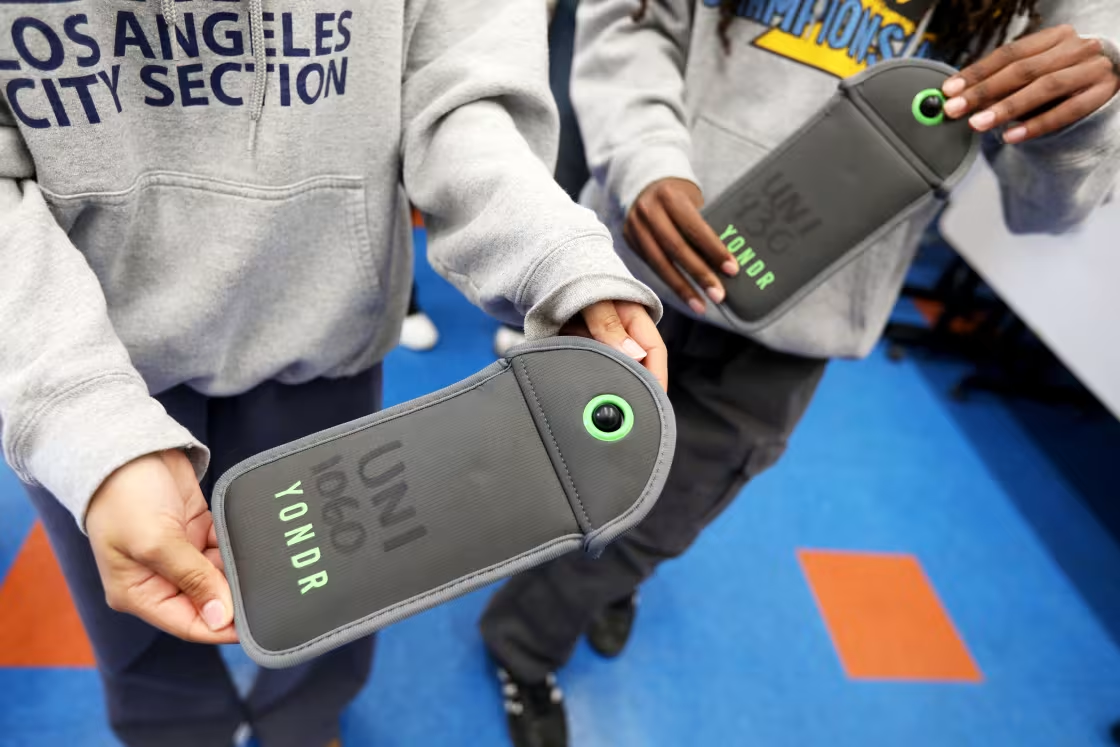
Students using a Yondr Pouch. Photo credit: Genaro Molina via NBC News.
According to the Institute of Education Sciences, around the United States 77% of public schools have restricted phone use during class since February 2025. They also stated 38% of public schools have taken the next step in the movement away from phones, limiting access to them for the entire school day.
One way phone usage is being limited in some schools is the Yondr Pouch. These pouches lock the phones to restrict access but allow the students to keep their phones on them during the school day. One downside to these pouches is that they cost school districts 30 dollars each, causing them to be major investments for the roughly one thousand schools that use them.

Former Virginia Governor Glenn Youngkin. Photo credit: Virginia Guard Public Affairs via Flickr.
Glenn Youngkin, Governor of Virginia from 2022-2026, issued Executive Order 33 for Virginia public schools on July 9, 2024, creating phone-free education in public schools in response to people’s concerns. Youngkin explained how the order was “to protect the health and safety of students in Virginia’s K-12 public schools.” The text of the order states, “Parents, public health professionals, educators, and other stakeholders across the Commonwealth are expressing concern over the alarming mental health crisis and chronic health conditions affecting adolescents, such as depression and anxiety, driven in part by extensive social media usage and widespread cell phone possession among children.” Worries and data about screen time usage, the notifications teenagers receive, and the impacts on the brain led to a societal push, with parents, doctors, government officials and speaking out against screen usage to protect children’s minds and hearts.
After Executive Order 33 was issued, the Virginia Department of Education (VDOE) provided guidance on how to implement these new regulations regarding phones in public schools. How these regulations have been implemented vary from school to school, but the reasons behind them are the same. As the VDOE state on their website, “it is essential that students have the opportunity to develop face-to-face conversations and develop critical in-person communication skills during unstructured school hours.”
Henrico County Public Schools announced their commitment to phone-free education entering the 2024-2025 school year. According to their website, “middle and high school students must keep cell phones, smartwatches and other personal internet-connected devices stored and silenced during class and after-school instructional activities.” They also stated that, starting in 2024, “every classroom will have pouches or containers where devices can be securely stored when they are not in student backpacks.” Elementary students are prohibited from being on their devices at school, but middle and high schoolers are able to use their phones in between classes and during lunch. The district also stated these guidelines would be put into action by the Code of Student Conduct.
Landon Burke, a senior at Henrico’s Glen Allen High School, said in a recent interview that the phone policy is set up so “we get to our first class and put it in the box, and then with about five minutes left [in class], we take it out, go to our next class, and put it in the next box, and so on.” The policy with the pouches and boxes started last year. This school year, Glen Allen stopped allowing phones during transitions and lunch, hoping to forge more connections among students, but not all students abide by the new rules.
Burke explained that how teachers implement the phone policy at Glen Allen varies from teacher to teacher: “Some make us put it in, and some don’t care if we do or don’t. As long as they don’t see it, they’re fine.” While some teachers do not particularly care if a phone is in the box or not, they still value a phone-free environment. Burke also said that the policy is not always effective, because some teachers do not care enough if they see a phone. Burke said, “the phone policy does not make a difference overall, because I barely touch my phone anyways.”
Goochland Public Schools have taken a different approach in how they handle devices at school. Goochland High School junior Addi Tindel explained how “when you get to school, you’re supposed to go to your last class of the day and put your phone in a lock box, and then at the end of the day you have to retrieve it.” While the system sounds successful, it is not implemented well. Tindel said, “no one really does it,” and one reason is because of how difficult it is to get to school early enough. Teachers still ensure phones are not out during lessons, but there is no punishment for a student’s phone not being placed in the lock box. There is a consequence, however, “if a teacher sees [a phone] out at all, then they have to call the office, and the office takes it and holds it up there until the end of the day.”
Teachers at Goochland High still make sure students are paying attention and are focused during class, but the lock boxes are rarely used. Tindal acknowledged that “having your phone is a responsibility,” and that being on your phone while the teacher is lecturing hurts the student’s education.

Collegiate’s phone locker system. Photo credit: Perry Smith.
Collegiate changed their phone policies for the 2024-2025 school year. In 2024-2025, the Upper School instituted phone lockers. Upper School Director of Student Life Beth Kondorossy recently explained how “watching more and more research about the impacts of social media, cell phones, and screens on young people” eventually pushed Collegiate to intervene more significantly. Each morning, Upper School students are required to place their phone in a locker full of personally labeled pouches. Kondorossy and other administrators check the lockers each morning. She stated, “I think the system is great” and very few people forget to pocket their phone. She added that another advantage is that “it’s a great way to also keep attendance.”
When asked about Collegiate’s phone policy, Virginia Harris (‘27) remembered how, in the beginning, she thought it was hard, “but now I think that it’s just like part of my day.” She also thinks the new phone policy helps her focus on schoolwork better in her free periods and also “talk to my friends more and connect more.”
Connection was one of the driving factors for the phone policy changes in Collegiate’s Upper School. Being tied to phones limits connection and the ability to be present. This new policy has greatly benefited the Collegiate community. Harris summed it up by saying, “instead of scrolling, you can connect with people in real life,” and that for our school overall, “the policy is really good.”


Recent Comments